Key Features
-
Intuitive, color-coded decode overlays for clear signal interpretation
-
Interactive protocol tables with zoom and advanced pattern search capabilities
-
Automated timing measurements for faster validation and analysis
-
Comprehensive trigger and decoder support for 10Base-T1S and OA3p commands, MDIO traffic, Beacon, ID, Commit/Sync, CRC errors, and includes automatic Node ID detection for fast setup (10Base-T1S)
-
Filtering by node ID and Eye Diagrams with failure location identify physical layer issues (10Base-T1S)
-
Integrated equalizer improves decoding of real-world signals (100/1000Base-T1)
-
Bidirectional coupler with built-in calibration provides superior signal fidelity (100/1000Base-T1)
-
Debug link start-up handshaking enables deep system insight (100/1000Base-T1)
-
PAM3 Eye Diagram lets characterize system performance (100/1000Base-T1)
Trigger Flexibly ("T")
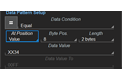
The bundle delivers highly flexible triggering for 10Base‑T1S, enabling engineers to isolate the exact events and data patterns they need. Conditional DATA triggers allow value‑based or range‑based triggering on 10Base‑T1S traffic, ideal for detecting abnormal states or sensor anomalies. Startup‑phase triggering for 100Base‑T1 and 1000Base‑T1 provides deep visibility into the Master/Slave link‑training process. The oscilloscope can trigger on, capture, and decode the complete startup handshaking sequence, tracking the exact state each device enters during negotiation.
Intuitive, Color-coded Decode Overlays ("D")
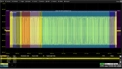
A transparent overlay with color-coding for specific portions of each protocol and the entire message frame makes it easy to understand your serial data information. Unlike other solutions, with protocol decode information away from the signal, our solution correlates the waveform and the protocol decode directly on the display. As the acquisition length is expanded or shortened, the decode overlay will adjust to show you just the right amount of information.
Interactive Table Summarizes Results ("D")
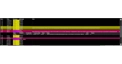
The interactive protocol table transforms the oscilloscope into a multi‑protocol analyzer for 10Base‑T1S, OA3p, 100Base‑T1, and 1000Base‑T1. Users can filter by Node ID, address, command type, or specific data fields to instantly isolate packets of interest. Touching any table entry automatically zooms to the corresponding waveform for immediate correlation. For OA3p, the table presents MDIO, Rx, Tx, and MDI activity simultaneously, while for 100/1000Base‑T1 it tracks equalized and raw signal states during startup negotiation. This multi‑layer view accelerates root‑cause analysis by linking protocol behavior to physical‑layer conditions across all Automotive Ethernet speeds.
Measure/Graph Tools for Validation Efficiency ("M")
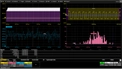
Comprehensive Measure/Graph tools provide automated timing, correlation, and long‑run statistics for all three technologies. Engineers can extract serial values to analog (serial‑DAC), track system behavior over time, and quantify effects during corner‑case testing.
Eye Diagrams ("E")
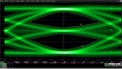
Eye‑diagram tools provide fast, setup‑free visibility into signal quality across 10Base‑T1S, 100Base‑T1, and 1000Base‑T1. For 10Base‑T1S, engineers can filter by arbitration ID or protocol‑table fields to correlate degraded eye openings with specific frames, enabling rapid root‑cause identification of signal‑integrity issues. For 100Base‑T1 and 1000Base‑T1, PAM3 eye diagrams fully characterize link performance using 12 key parameters—including upper/lower eye height and width—and display BER contours to visualize system margin. Mask hits can force Stop mode, ensuring no critical events are missed. These tools provide complete signal‑quality insight across the full range of Automotive Ethernet links.
Physical‑Layer Insight ("P")
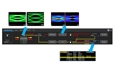
For 100Base‑T1 and 1000Base‑T1, integrated equalizers emulate real receiver behavior and decode real‑world PAM3 signals—even in the presence of distortion or channel loss. Bi‑directional coupler calibration enhances signal fidelity, enabling accurate separation of Master and Slave paths. Engineers gain a complete, end‑to‑end view of link behavior, from protocol stimulus to analog response