Radar Signal Analysis With Oscilloscope Demodulation
Learn how oscilloscope demodulation and FFTs reveal radar pulse envelopes, Barker-coded phase modulation, chirp behavior, and frequency content.
Learn how oscilloscope demodulation and FFTs reveal radar pulse envelopes, Barker-coded phase modulation, chirp behavior, and frequency content.

This article explains the expected behavior of on-die power rails during CMOS switching events, including PDN current flow, clock-edge noise, and asymmetric current draw between switching and latching operations.

Learn how oscilloscope histograms help characterize component specifications by comparing propagation delay, mean, standard deviation, and measurement spread under different conditions.

This article explains the fundamentals of Differential Manchester Encoding, including self-clocking behavior, transition-based data representation, and its role in Automotive Ethernet applications.


Differential Manchester Encoding (DME) is an example of a differential, bi-phase encoding technology. DME is specified in the IEEE 802.5 standard for Token Ring local area network (LAN) topology.
Manchester is categorized as bi-phase encoding because the signal is checked twice every bit interval, also called self-clocking. Each check is one “tick”, each bit interval equals two ticks of the clock. This removes the need for the separate clock signal that is required for Non-Return to Zero (NRZ) encoding. Instead, data and clock signals are combined into a single, two-level, self-synchronizing data stream. The clock can be "extracted" by measuring the timing of the edges.
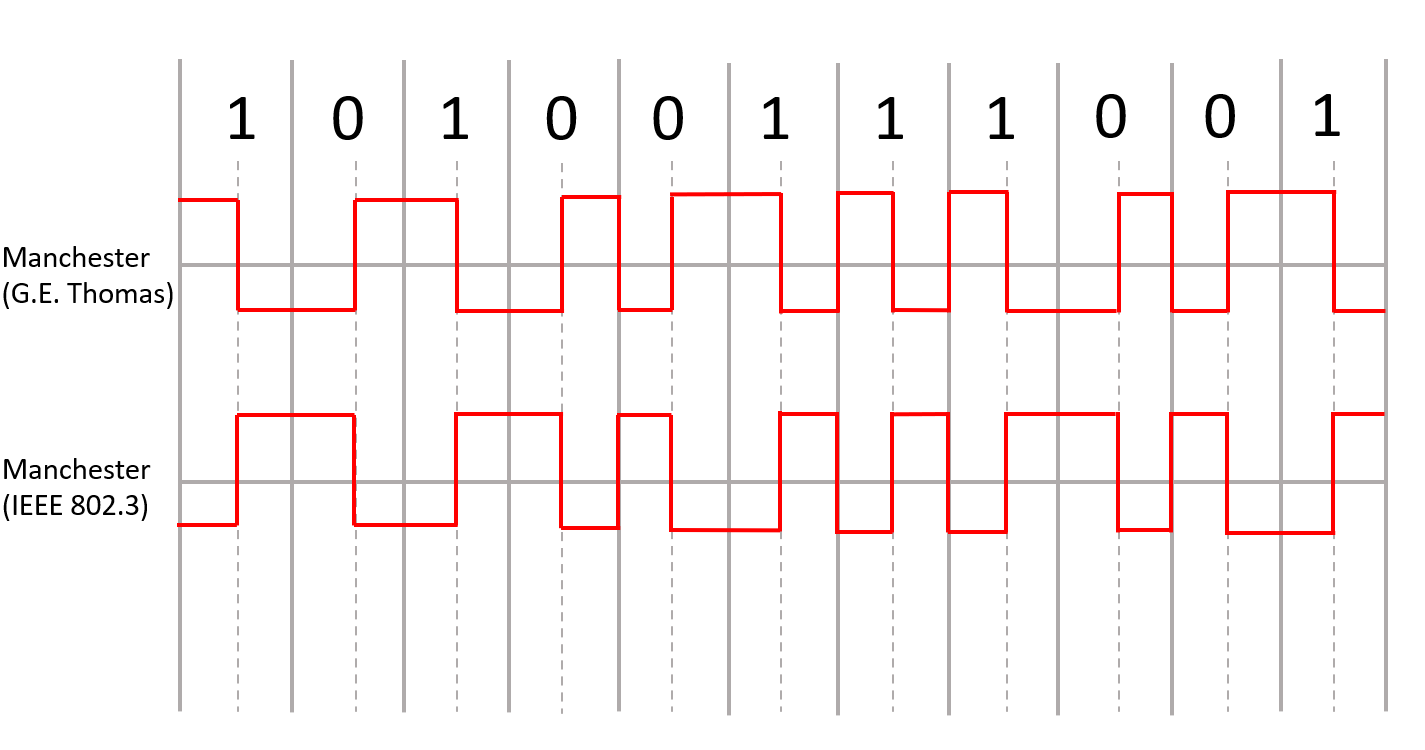
In Manchester encoding, we see a digital modulation scheme where voltage transitions rather than voltage levels are used to represent 1s and 0s. In IEEE 802.3 Manchester, a high-to-low transition occurring in the middle of the bit interval represents logical 0, while a low-to-high transition represents logical 1 (the G.E. Thomas variant reverses this logic). Significant transitions always occur in the middle of the bit interval to ensure clock synchronization. Transitions at the start of a period are only used to reset the polarity to achieve the proper transition for the next bit. This increases error detection capabilities, compared to NRZ, but also increases the bandwidth needed to transmit the signal at the same data rate, making it a better candidate for short-distance applications.
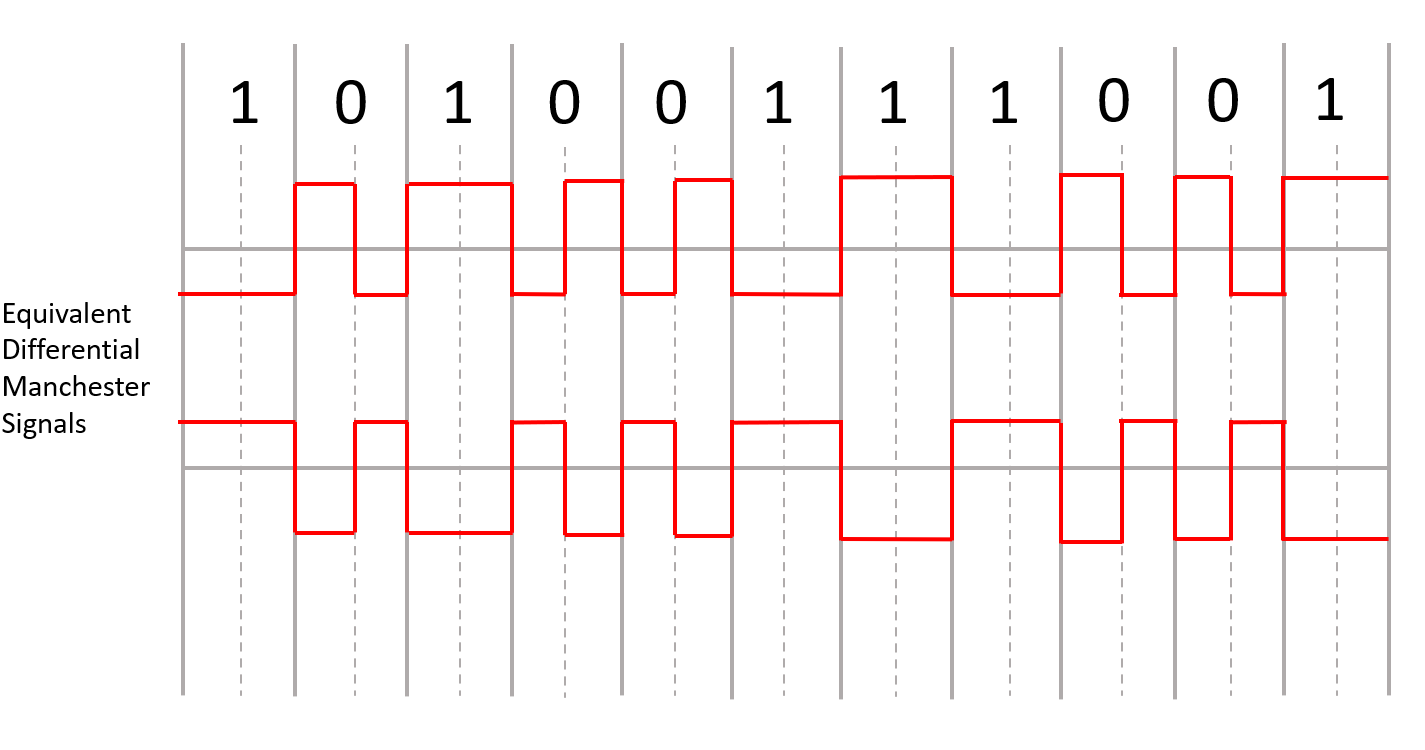
The most prominent feature that distinguishes DME from classic Manchester encoding is that, in DME only the presence or absence of a transition during the bit interval is important, not the polarity. The presence of a transition represents a logical 0, while the absence of a transition represents a logical 1. Whether the signal goes line-high or line-low depends simply on its state the previous bit interval. This increases bit rate at lower bandwidths, because one bit is guaranteed to occur every interval. It also helps with data recovery in noisy environments, like automotive, because DME allows for a data stream to be inverted, yet still be properly decoded, unlike classic Manchester where the polarity is significant.
Differential Manchester Encoding is used for 10Base-T1S Automotive Ethernet, a short-distance, low-bandwidth application with either a point-to-point or bus topology up to 25 m.
Copyright © 2020-2026 Teledyne LeCroy. All rights reserved. All original content, including text and photos, is the property of Teledyne LeCroy and cannot be reproduced without expressed written permission.

Learn how inter-symbol interference causes bits to leak into later unit intervals through reflections, group delay dispersion, and channel losses.

Channel equalization uses transmitter and receiver techniques to counteract losses, reduce ISI, and improve signal quality in high-speed data links.

Transmit de-emphasis enhances eye diagrams by reducing inter-symbol interference, improving signal clarity at the cost of lower overall amplitude.

Continuous Time Linear Equalization (CTLE) enhances high-speed serial signals by compensating for channel loss, improving eye openings while balancing noise performance.