Radar Signal Analysis With Oscilloscope Demodulation
Learn how oscilloscope demodulation and FFTs reveal radar pulse envelopes, Barker-coded phase modulation, chirp behavior, and frequency content.
Learn how oscilloscope demodulation and FFTs reveal radar pulse envelopes, Barker-coded phase modulation, chirp behavior, and frequency content.

This article explains the expected behavior of on-die power rails during CMOS switching events, including PDN current flow, clock-edge noise, and asymmetric current draw between switching and latching operations.

Learn how oscilloscope histograms help characterize component specifications by comparing propagation delay, mean, standard deviation, and measurement spread under different conditions.

This article introduces the RP2060 and RP4060 power rail probes, designed for modern 48 V power architectures with high offset capability, low-noise measurements, and high-bandwidth power integrity analysis.


In 2016, Teledyne LeCroy first offered the RP4030 Power Rail Probe, which was designed to enable engineers to probe a low-impedance, low-voltage DC power/voltage rail signal without loading the device under test (DUT). It provided ±30 V of probe offset to allow a DC power/voltage rail signal to be displayed in the vertical center of the oscilloscope regardless of the gain (sensitivity) setting.
More recently, 48-56 Vdc battery-powered tool deployments increased and data center DC-DC converters standardized on 48 V power distribution. In response, Teledyne LeCroy released two, new power rail probes that build on those capabilities—the 2 GHz RP2060 and 4 GHz RP4060. Both probes feature:
*Bandwidths listed are for the 4 GHz RP4060. Maximum bandwidth when used with RP2060 is 2 GHz.
One driver of the new release is the increase in the number and size of data centers needed to support cloud computing and other data-intensive applications, and the new power architectures they require. The new rail probe is designed to ideally meet the needs of engineers working with power rails rated up to 48 Vdc.
To power individual servers in the racks that make up data centers, traditional “server farms” would step down power to the 12 Vdc needed to input to the server, where within the server it would be further stepped down to the 5 V, 3 V, 1 V or less needed to power the many individual chips. In the process, much energy is lost to heat, which in turn requires more energy to cool, raising costs. The average data center with 12 or 24 Vdc power distribution uses an average of 3 kW to 5 kW of power per rack. Data centers with 48 Vdc power distribution use an 5-10 times that amount, requiring higher voltage to avoid very high current requirements.
Engineers designing data center components and products that use 48 Vdc power distribution architecture need to probe DC voltages anywhere from 1 V or less to 48 V, and the RP2060 and RP4060 meet this need. Ripple and small voltage perturbations (in the range of +/-800 mV) are easily measured with high precision by the rail probes using the built-in 16-bit offset DAC.
60 V rail probes are also great solutions for understanding ripple and signal integrity in other 48 V power conversion systems such as commonly used in battery-powered tools and garden equipment, such as 48 Vdc battery outputs, AC-DC charging supplies (which commonly operate at 56 Vdc output), and nominal 48 Vdc bus voltages used in power conversion circuits.
The input is through a high-bandwidth SMA connector, terminated to ground with a 50 kΩ resistor in parallel with a 0.1 μF capacitor. This provides high input impedance near DC and low input impedance at high frequencies―highly desirable for low-impedance DC power rail probing. A two- stage offset DAC provides ± 60 V range. This permits the offset value to be set with high accuracy (0.1% ±3 mV). The output is through a BNC connection to the Teledyne LeCroy ProBus interface into a 50 Ω oscilloscope termination. An Auto Zero grounding switch permits Auto Zero of the DC value at any time without having to disconnect the probe from the device under test (DUT). Reference Figure 1 for the details.
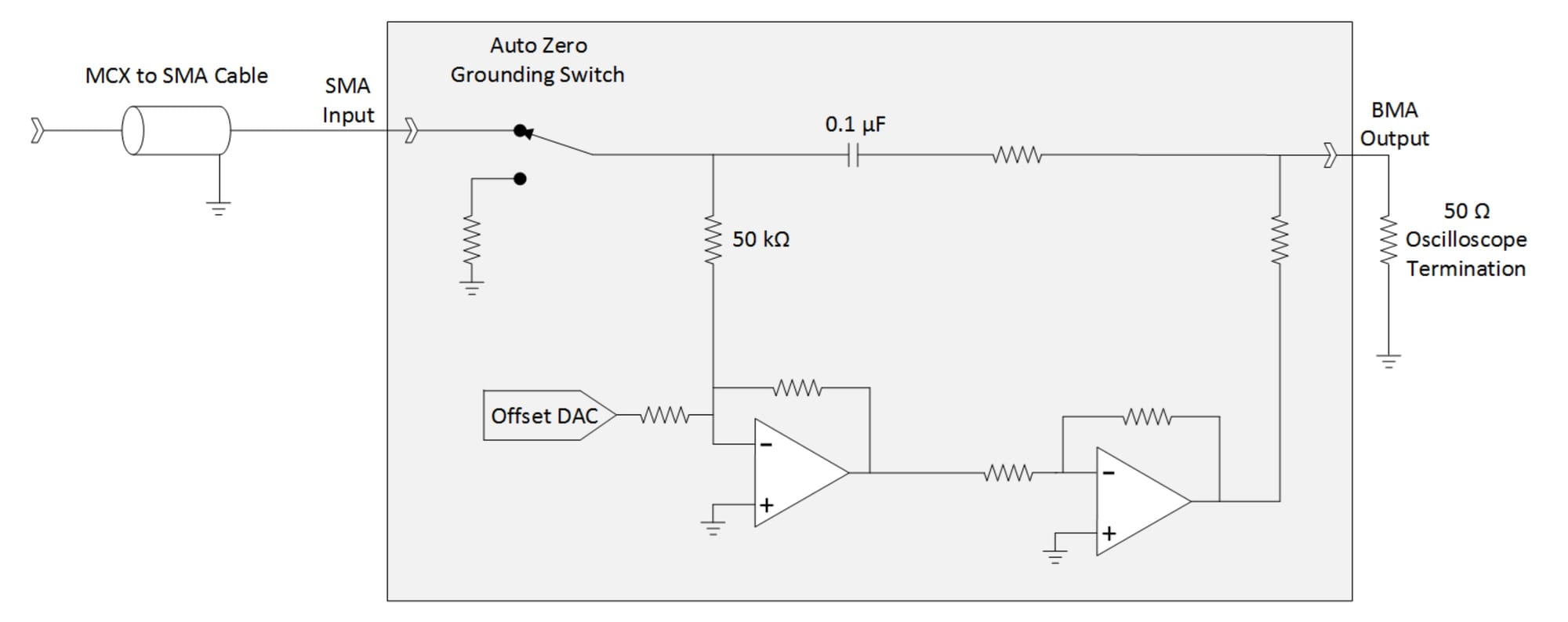
Note that some applications (>800 mV voltage excursions or full-range nominal 48 V signal step responses) would be better served with a different probe - Teledyne LeCroy's DL-HCM series. More on this in a future blog post.
Copyright © 2020-2026 Teledyne LeCroy. All rights reserved. All original content, including text and photos, is the property of Teledyne LeCroy and cannot be reproduced without expressed written permission.

This article explains the expected behavior of on-die power rails during CMOS switching events, including PDN current flow, clock-edge noise, and asymmetric current draw between switching and latching operations.

Instrumented microcontroller boards and active voltage-rail probes make it possible to directly observe on-die power rail behavior, including sag, noise, and ground bounce.

Dr. Eric Bogatin answers common ground bounce questions covering dI/dt, quiet-low measurements, return path discontinuities, via placement, TDR, and differential probing.

Accurate on-die power rail measurements depend on proper sense-line design, differential probing, and careful test setup at the package level.